Brand positioning: what it is and how to define yours.
Brand positioning is the place a company wants to hold in the customer’s mind: who it is for, what problem it solves and why it is the best choice. To define yours, listen to real customers, map the competition, choose a difference you can prove and sum it all up in one sentence that guides the website, the ads and the sales pitch.
 Fabrício Martins
Founder of Martin Marketing & Design
In short
- What it is: the clear reason to choose your company over the other options.
- What it is not: a slogan, a logo or a list of qualities any competitor would claim.
- How to define it: customers, competition, difference and a positioning statement.
- Where it shows up: in the website headline, in the ads, in customer service and in the visual identity.
What brand positioning is
Positioning is the short answer to the question every customer asks, even without realizing it: "why this company, and not another one?". When the answer is clear, choosing gets easier. When it is not, the customer decides on price.
The concept became known through Al Ries and Jack Trout, who introduced it in articles in the early 1970s and later in the book Positioning: The Battle for Your Mind. The central idea still holds: positioning does not happen in the product, but in the buyer’s perception. The company decides which place it wants to hold and works so that every touchpoint confirms that place.
Three things are often confused with positioning:
- A slogan. It is one way of communicating the positioning, not the positioning itself.
- A logo and colors. The visual identity expresses the positioning, but does not define it.
- A list of qualities. "Quality, commitment and good service" is what any competitor would say.
Why positioning matters
A company without clear positioning competes on everything and wins at nothing. In practice, this shows up as concrete problems:
| Without clear positioning | With clear positioning |
|---|---|
| Customers compare price only | Customers compare what matters to them |
| Ads talk to everyone and convince few people | Ads talk to the right audience, and the cost per lead drops |
| Each person on the team explains the company differently | Customer service, sales and the website tell the same story |
| Many leads arrive outside the target profile | Fewer leads arrive, and better ones |
| Every new piece starts from scratch | Website, ads and content start from the same foundation |
Positioning is also what gives design work its meaning. A beautiful visual identity without a clear idea behind it becomes decoration. With positioning, every choice of color, type and image has a reason.
The most common types of positioning
There are several ways to hold a place in the customer’s mind. The most common ones, with hypothetical examples:
| Type | Example | When it works |
|---|---|---|
| Specialization | Accounting only for medical clinics | When the niche has its own problems and pays for people who understand them |
| Audience | A gym for people over 50 | When a group feels poorly served by the generic options |
| Benefit | Blinds installed in a single day, with no mess | When there is a clear pain and the company solves it better |
| Premium price | Catering with a signature menu and a dedicated team | When the delivery justifies the price and the customer wants the best |
| Affordable price | Ready-made websites for small businesses, at a fixed price | When the company has a lean process to protect its margin |
| Convenience | A clinic with extended hours and booking via WhatsApp | When the customer’s time is worth more than the price difference |
You can combine two types, such as specialization and benefit. Beyond that, the message loses strength. The rule of thumb: if you need a paragraph to explain your place, you have not chosen one yet.
Step 1: listen to the customers you already have
The strongest positioning is almost never invented in a meeting room. It already exists, scattered across the reasons why the best customers chose the company. The work is to find and organize those reasons.
Talk to five to ten good customers, ideally those who bring the most results and the fewest headaches. Questions that work:
- What problem made you look for a company like ours?
- What other options did you consider?
- Why did you choose us?
- If our company stopped existing, what would you do?
- How would you describe us to a friend?
Write down the exact words. If three different customers say "you explain everything before you start", that is a perceived difference, and it is probably worth more than any sentence the company could create. Google reviews and thank-you messages are another valuable source.
Step 2: map the competition
Positioning is always relative. A place only exists in comparison with the others. Choose five to eight competitors, including the ones customers mentioned, and fill in a simple table:
| Competitor | What it promises | Who it talks to | Price range | Weak spot |
|---|---|---|---|---|
| Competitor A | Lowest price | Everyone | Low | Slow service |
| Competitor B | Tradition | Long-standing customers | High | Outdated communication |
| Competitor C | Technology | Large companies | High | Little attention to small accounts |
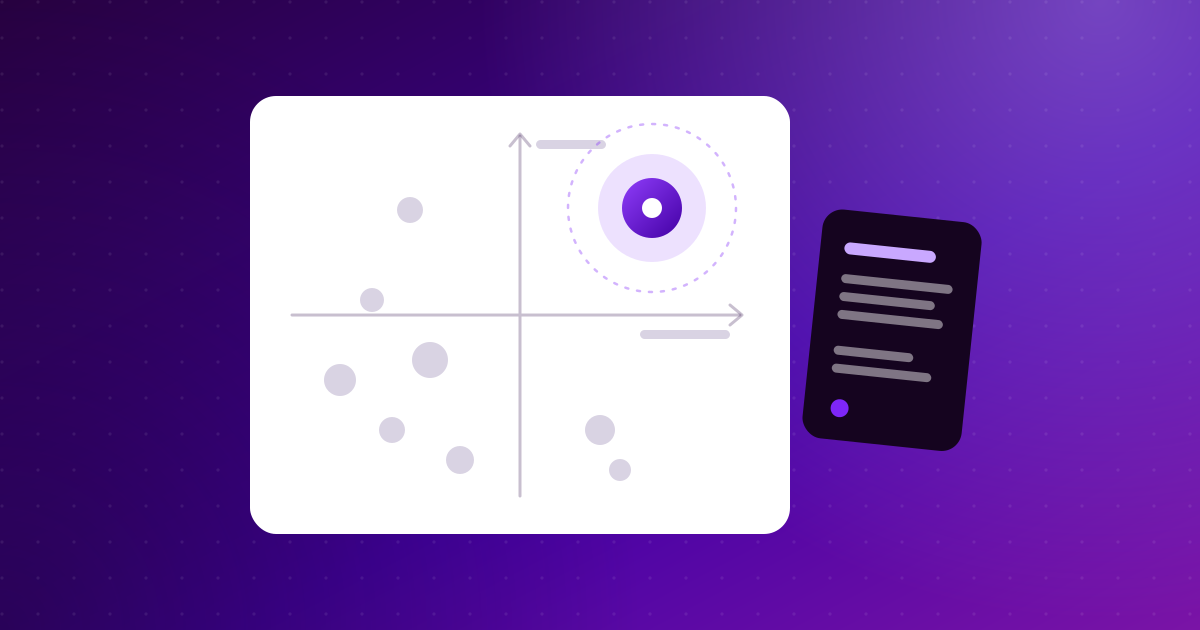
Then draw a map with two axes that matter to the customer, such as price and specialization, or speed and personalization. Place each competitor on the map. The empty spaces are opportunities, as long as there are people looking for that.
An empty space is not the same as an opportunity. Sometimes nobody is there because nobody wants it. The conversations from step 1 tell you whether the space has demand.
Step 3: choose a difference you can prove
With customers heard and the competition mapped, a few options for a difference appear. To choose, run each one through four filters:
- Is it true? The company delivers it today, consistently, and not only on its best days.
- Is it relevant? The customer cares about it when deciding.
- Is it different? The main competitors do not say the same thing.
- Can you prove it? There is a number, process, guarantee, testimonial or case that backs up the promise.
One difference that passes all four filters is worth more than three that pass two. If none passes, the work is not about communication: it is about operations. First the company changes what it delivers, then it changes what it says.
Step 4: write the positioning statement
The positioning statement is an internal document. It does not need to be beautiful, it needs to be precise. A template that works:
For [audience] that [need or problem], [company] is the [category] that [main benefit], because [proof].
A hypothetical example, for a dental clinic:
"For adults who put off the dentist out of fear, the clinic is the dental practice that treats them without surprises, because it explains each step before starting and offers conscious sedation when the patient needs it."
Notice that the statement excludes people: it does not speak to those looking for the lowest price or to those who want high-end cosmetic work. That is on purpose. Good positioning chooses who it is not for.
Once it is written, test the statement with three questions: could a competitor sign the same sentence? Would a customer recognize the company in it? Can the team explain it in their own words? If the answer to the first one is yes, go back to step 3.
Before and after examples
The difference between a generic message and a positioned one usually lies in the first words on the website. Three hypothetical examples:
| Before | After |
|---|---|
| "Complete accounting solutions, with quality and commitment" | "Accounting for medical clinics: taxes, payroll and insurance payouts in one place" |
| "Your body in motion, with the best professionals" | "Training for people over 50, with close guidance and no rush" |
| "Tasteful decor for your home" | "Blinds and curtains installed in a day, with free measuring and no renovation work" |
Notice what changes: the "after" says who it is for, which problem it solves and gives a concrete detail. People outside the audience notice right away, and that is good too.
How to bring positioning into everyday work
Positioning only exists for the customer when it shows up everywhere they meet the company:
| Touchpoint | What changes |
|---|---|
| Website headline | It says who the company is for and the main benefit, instead of a generic phrase |
| Ads | They speak to the chosen audience, using customers’ own words |
| Visual identity | Colors, type and images reinforce the chosen place, whether premium, technical or welcoming |
| Customer service | The team tells the same story and answers objections the same way |
| Sales proposal | It brings proof of the difference: numbers, process, cases and guarantees |
| Google profile and social media | The description uses the same core sentence, adapted to the space |
For the visual side, the articles on how to create a visual identity and on brand guidelines show how to turn positioning into a system that repeats across any piece.
When it is time to reposition
Positioning is not meant to change every year, but it is not forever either. A few signs show it is time to review it:
- The sales conversation has turned into price negotiation only. Customers no longer see a difference.
- The company changed and the brand did not keep up. New services, a new audience, a new price level.
- A competitor took your place. And does it with more resources.
- Customers describe the company differently from how it describes itself. And their version is better.
- The leads coming in are outside the target profile. The communication attracts the wrong audience.
Repositioning does not require changing the name or the logo. Most of the time, it starts with the message and the website, and the visual identity adjusts later, if needed.
Common mistakes
- Wanting to talk to everyone. The message gets so broad that it convinces no one.
- A generic difference. Quality, service and commitment are the minimum, not a difference.
- Copying the market leader. Its place is already taken, by the leader.
- Promising what operations cannot deliver. Customers find out on their first experience.
- Changing with every campaign. Positioning is built through repetition over time.
Frequently asked questions
Positioning is the idea: who the company is for and why it should be chosen. Visual identity is the form: the logo, colors, type and images that express that idea. Positioning comes first, because it guides the visual choices.
Yes, and that is where it makes the biggest difference. With a small budget, a company cannot compete by talking to everyone. Clear positioning lets it spend less to attract the right customer and charge a fair price for what it delivers.
The definition work, with customer conversations, competitive analysis and writing the statement, usually takes two to four weeks. Market perception takes longer, because it depends on customers meeting the same message several times.
No. Positioning is a strategic decision, usually written as an internal statement. A slogan is one way of communicating that decision to the public, in a short and memorable form. Many strong brands do not even have a slogan.
Yes, and sometimes it is necessary, when the company changes its audience, service or price range. The care is to change for a reason and all at once, updating the website, ads and customer service together, instead of changing bit by bit and confusing customers.
Conclusion
Defining brand positioning means choosing a place and backing that choice in everything the company does. Start with customers, look at the competition, choose a difference you can prove and write the statement. The rest of your communication gets easier from there.
If you want to do this work together with your visual identity, take a look at Martin’s branding and visual identity work.